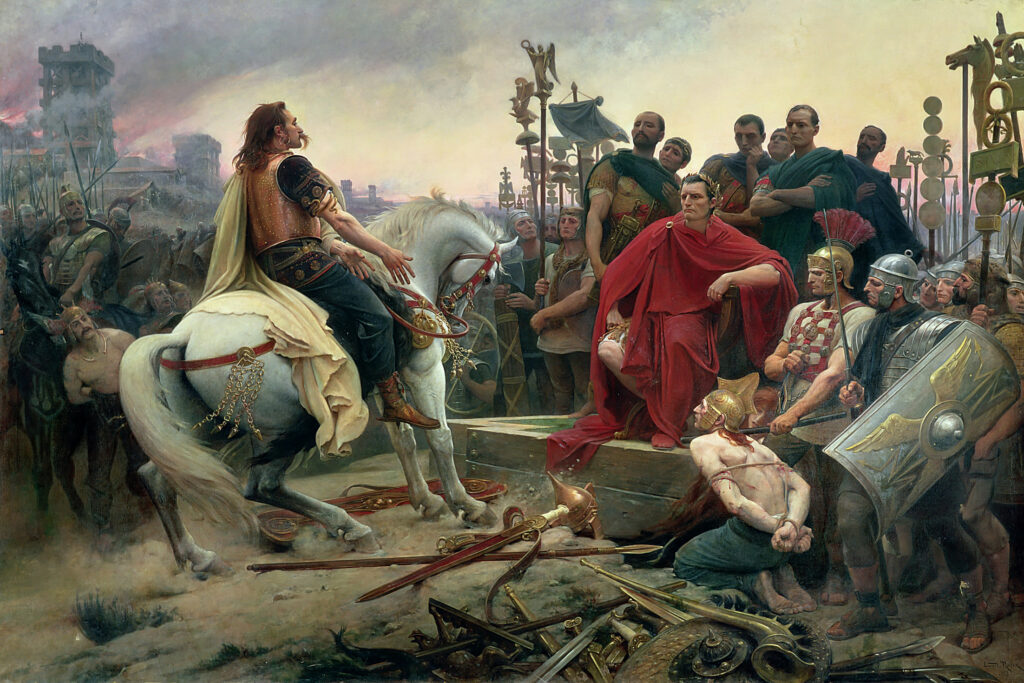
https://commons.wikimedia.org/wiki/File:Lionel_Royer_-_Vercingetorix_Throwing_down_His_Weapons_at_the_feet_of_Julius_Caesar.jpg”>Lionel Royer, Public domain, via Wikimedia Commons
In preparing to teach a recent lesson about Roman battles, I learned about the seizure of a settlement named Alesia (in modern day France) led by Julius Caesar in 52 BC. The battle is famous for Caesar’s dastardly plan to build two surrounding walls around Alesia; one to trap and thereby starve the 80,000 Gallic residents of the fortress city and the other wall to keep out any Gauls who might attack from beyond Alesia. The battle pitted Caesar’s army against a Gallic tribe commanded by a chieftain known as Vercingetorix. This name alone and my wonderings about its correct pronunciation led to an internet search and an ‘encounter’ with a painting (see above) depicting the moment of Vercingetorix’s surrender to Caesar. The painting titled: Vercingetorix jette ses armes aux pieds de Jules César (translation –Vercingetorix throws down his arms at the feet of Julius Caesar) by French artist Lionel Royer (1852–1926) is an image of sheer drama and captured my attention immediately upon viewing.
The central point of focus is Vercingetorix’s act of throwing down his weapons before Caesar, but there is so much more going on in the painting than that. Each character plays a role that heightens the drama of this climactic moment. Undoubtedly Vercingetorix and Caesar take centre stage, meeting for the first time perhaps and performing the roles of ruler and rebel in front of a crowd who cannot hide their fascination for this long haired Gallic ‘ruffian’. All eyes are on Vercingetorix and even a kneeling and rope-bound Gallic prisoner who like a dog is being controlled by a stick, ignores the Roman guards to look upwards at his chief.
Vercingetorix, the undoubted hero of this painting, is elevated above everyone. Seated on a resplendent horse with his chin held high, he gazes contemptuously over the head of Caesar. Similarly elevated on a wooden ‘throne’ atop a raised platform, Caesar narrows his eyes and strikes a confident pose to survey the enemy before him, ironically unaware that his protective entourage of guards lean backwards and appear to be somewhat in awe of Vercingetorix rather than ready to ‘pounce’!
As a Drama practitioner, I can’t help but think this painting is begging to be replicated by a human tableau. Drama techniques such as hot seating could be used to interrogate the moment and the different emotions of the characters within the painting. I’ll have to hold that thought until I get the opportunity to do exactly that. In the meantime I am just so glad to have encountered this painting and to have had my imagination set alight by an incredible work of art (which I have added to my ‘bucket list’ to view one day). I hope you enjoy it too!
Leave a Reply
You must be logged in to post a comment.