Now, call me weird but I really enjoy analysing texts – it’s a bit like being a detective, sniffing around for literary devices that enhance the reading experience and in fact recently, I enjoyed an extract so much that ‘reader, I ordered the book’!
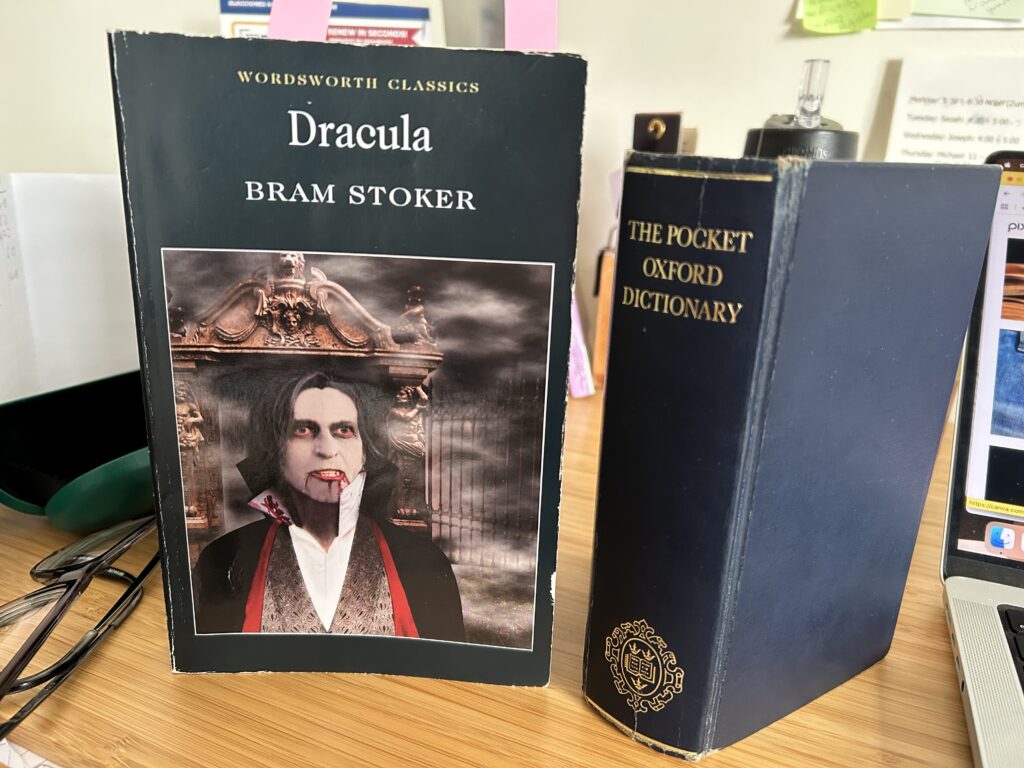
The book in question was ‘Dracula’ by Bram Stoker and I was working with students to investigate its suspenseful atmosphere. As I did not have time to read the book in full before an approaching lesson, the moment the book dropped through my letterbox I began skimming pages in search of those literary ‘tools of suspense’. My hovering highlighter stopped abruptly at the following sentence, “The strength of the handshake was so much akin to that which I had noticed in the driver, whose face I had not seen, that for a moment I doubted if it were not the same person to whom I was speaking” (p. 15[1]). This portentous observation occurs when the narrator, Mr Harker, meets Count Dracula seemingly for the first time but the English teacher within was immediately alerted, “Methinks the author is implying something significant here…” As the meeting with the driver had already happened, I knew this wasn’t the literary device of ‘foreshadowing’, and so I wondered if there were such a device as ‘backshadowing’? A quick search on the web revealed that backshadowing is indeed an acknowledged literary technique, defined as “a reference to something in the past that is impacting the present”[2]. So I traced back through the pages to the incident when Mr Harker does indeed experience the strong hand of the driver and on page 11 there it was; “Then I descended from the side of the coach, as the calèche was close alongside, the driver helping me with a hand which caught my arm in a grip of steel; his strength must have been prodigious.”
When sharing my detective work with a student, she became similarly hooked on this unfolding tale of suspense and its unfamiliar, sometimes archaic, language. Thankfully the ‘strange’ words did not detract from her enjoyment of the extract because she has developed a strong attachment to my small but perfectly formed 1978 sixth edition Pocket Oxford Dictionary! As she read portions of the text aloud, she would stop at an unknown word and scour the densely populated dictionary pages to find its meaning. Indeed by the end of the lesson she had looked up the following words: alacrity, prodigious, calèche, aquiline, scantily (with reference to hair!) and pallor and – I had to confess that I was thankful for her diligence as I too learned the meaning of certain words – ‘calèche’ anyone?
In conclusion, as I reflect on how much I have learned through preparing and teaching this one lesson, I also hope that the student’s enthusiasm for new (or should that be old?) vocabulary foreshadows an interest in classic literature that will last her a lifetime…
[1] Dracula by Bram Stoker, published by Wordsworth Editions Ltd, 1993
[2] https://medium.com/@thevegantriathleteblog/top-5-literary-devices-to-incorporate-into-your-writing-5f520542707f