The Drama of a Painting

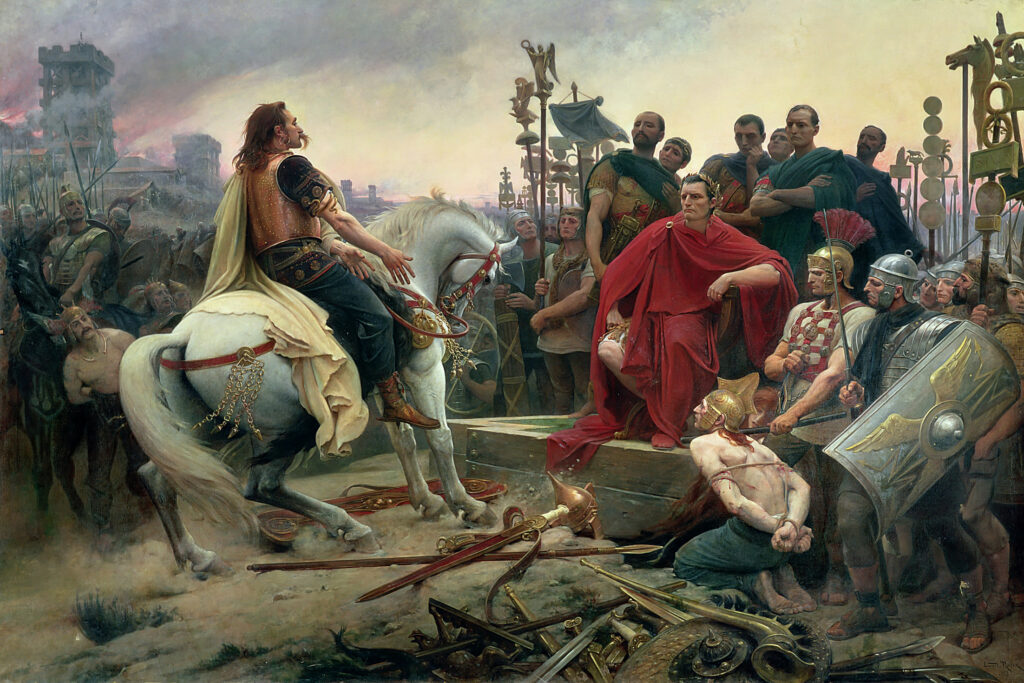
https://commons.wikimedia.org/wiki/File:Lionel_Royer_-_Vercingetorix_Throwing_down_His_Weapons_at_the_feet_of_Julius_Caesar.jpg”>Lionel Royer, Public domain, via Wikimedia Commons

In preparing to teach a recent lesson about Roman battles, I learned about the seizure of a settlement named Alesia (in modern day France) led by Julius Caesar in 52 BC. The battle is famous for Caesar’s dastardly plan to build two surrounding walls around Alesia; one to trap and thereby starve the 80,000 Gallic residents of the fortress city and the other wall to keep out any Gauls who might attack from beyond Alesia. The battle pitted Caesar’s army against a Gallic tribe commanded by a chieftain known as Vercingetorix. This name alone and my wonderings about its correct pronunciation led to an internet search and an ‘encounter’ with a painting (see above) depicting the moment of Vercingetorix’s surrender to Caesar. The painting titled: Vercingetorix jette ses armes aux pieds de Jules César (translation –Vercingetorix throws down his arms at the feet of Julius Caesar) by French artist Lionel Royer (1852–1926) is an image of sheer drama and captured my attention immediately upon viewing.

The central point of focus is Vercingetorix’s act of throwing down his weapons before Caesar, but there is so much more going on in the painting than that. Each character plays a role that heightens the drama of this climactic moment. Undoubtedly Vercingetorix and Caesar take centre stage, meeting for the first time perhaps and performing the roles of ruler and rebel in front of a crowd who cannot hide their fascination for this long haired Gallic ‘ruffian’. All eyes are on Vercingetorix and even a kneeling and rope-bound Gallic prisoner who like a dog is being controlled by a stick, ignores the Roman guards to look upwards at his chief.

Vercingetorix, the undoubted hero of this painting, is elevated above everyone. Seated on a resplendent horse with his chin held high, he gazes contemptuously over the head of Caesar. Similarly elevated on a wooden ‘throne’ atop a raised platform, Caesar narrows his eyes and strikes a confident pose to survey the enemy before him, ironically unaware that his protective entourage of guards lean backwards and appear to be somewhat in awe of Vercingetorix rather than ready to ‘pounce’!

As a Drama practitioner, I can’t help but think this painting is begging to be replicated by a human tableau. Drama techniques such as hot seating could be used to interrogate the moment and the different emotions of the characters within the painting. I’ll have to hold that thought until I get the opportunity to do exactly that. In the meantime I am just so glad to have encountered this painting and to have had my imagination set alight by an incredible work of art (which I have added to my ‘bucket list’ to view one day). I hope you enjoy it too!
Learning Through Tutoring

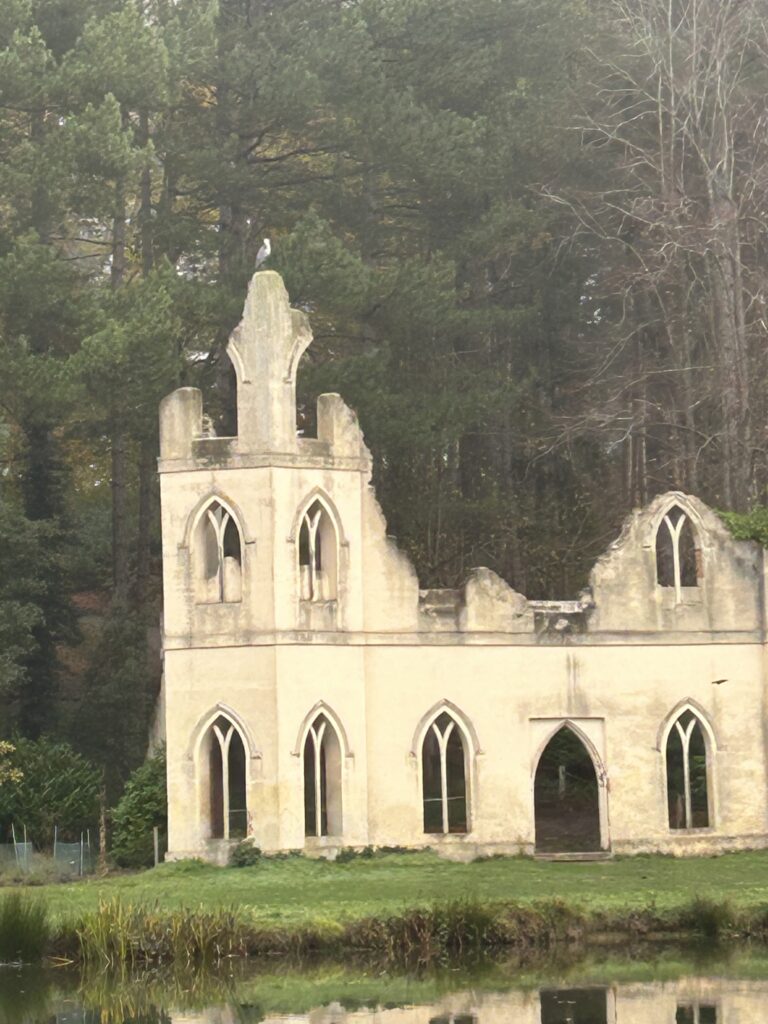
The Ruined Abbey at Painshill Park, Cobham. Suitably ‘spooky’ for the post below!https://www.painshill.co.uk/attractions/the-ruined-abbey/

Now, call me weird but I really enjoy analysing texts – it’s a bit like being a detective, sniffing around for literary devices that enhance the reading experience and in fact recently, I enjoyed an extract so much that ‘reader, I ordered the book’!

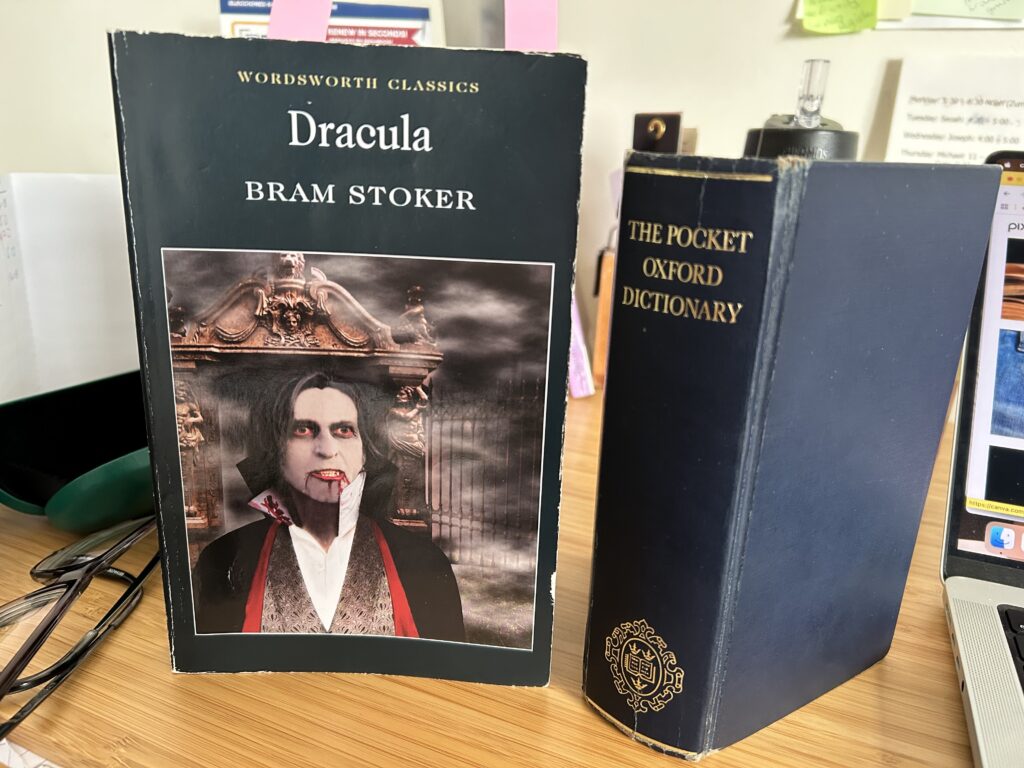
The book in question was ‘Dracula’ by Bram Stoker and I was working with students to investigate its suspenseful atmosphere. As I did not have time to read the book in full before an approaching lesson, the moment the book dropped through my letterbox I began skimming pages in search of those literary ‘tools of suspense’. My hovering highlighter stopped abruptly at the following sentence, “The strength of the handshake was so much akin to that which I had noticed in the driver, whose face I had not seen, that for a moment I doubted if it were not the same person to whom I was speaking” (p. 15[1]). This portentous observation occurs when the narrator, Mr Harker, meets Count Dracula seemingly for the first time but the English teacher within was immediately alerted, “Methinks the author is implying something significant here…” As the meeting with the driver had already happened, I knew this wasn’t the literary device of ‘foreshadowing’, and so I wondered if there were such a device as ‘backshadowing’? A quick search on the web revealed that backshadowing is indeed an acknowledged literary technique, defined as “a reference to something in the past that is impacting the present”[2]. So I traced back through the pages to the incident when Mr Harker does indeed experience the strong hand of the driver and on page 11 there it was; “Then I descended from the side of the coach, as the calèche was close alongside, the driver helping me with a hand which caught my arm in a grip of steel; his strength must have been prodigious.”

When sharing my detective work with a student, she became similarly hooked on this unfolding tale of suspense and its unfamiliar, sometimes archaic, language. Thankfully the ‘strange’ words did not detract from her enjoyment of the extract because she has developed a strong attachment to my small but perfectly formed 1978 sixth edition Pocket Oxford Dictionary! As she read portions of the text aloud, she would stop at an unknown word and scour the densely populated dictionary pages to find its meaning. Indeed by the end of the lesson she had looked up the following words: alacrity, prodigious, calèche, aquiline, scantily (with reference to hair!) and pallor and – I had to confess that I was thankful for her diligence as I too learned the meaning of certain words – ‘calèche’ anyone?

In conclusion, as I reflect on how much I have learned through preparing and teaching this one lesson, I also hope that the student’s enthusiasm for new (or should that be old?) vocabulary foreshadows an interest in classic literature that will last her a lifetime…


[1] Dracula by Bram Stoker, published by Wordsworth Editions Ltd, 1993

[2] https://medium.com/@thevegantriathleteblog/top-5-literary-devices-to-incorporate-into-your-writing-5f520542707f

Going down the Wormhole

*image credit pixabay

It’s been a year since I started freelancing as a tutor and it’s been great. I love the freedom that tutoring brings in terms of work/home balance but especially joyous is the opportunity to create lessons that will engage students in the learning process and help them progress in their education.

What has really struck me though is how much I have learned! As a tutor I cover a range of topics and in preparing these cross curricular lessons, I frequently have to do my research first and study topics that I know little about! For example I have a student who is fascinated in outer space and particularly curious about the existence of ‘wormholes‘. They were an unknown concept for me but boy are they interesting and quite literally mind blowing (and mind bending!)

Another key feature of 1:1 tutoring lies with the individuality of each student. This may seem obvious and whilst in a classroom you are aware of the diversity of temperament and personality within the room, the crowded context does not allow for the week by week revealing of quirks, dislikes, interests and unique senses of humour that each student I tutor possesses. These ‘slow revealings’ guide me as I choose texts and plan activities that I am pretty sure will be appealing to a particular student. Of course this doesn’t always go according to plan but that is part of the teaching and learning process too – for student and tutor!

© 2026

Theme by Anders Norén — Up ↑